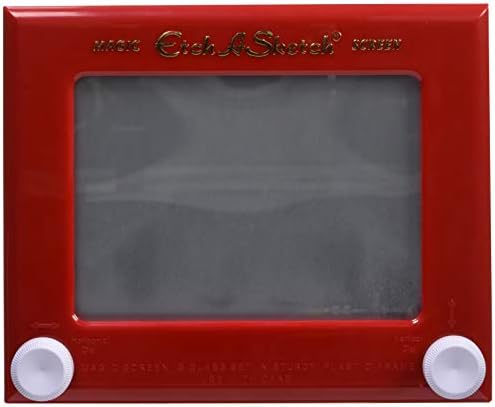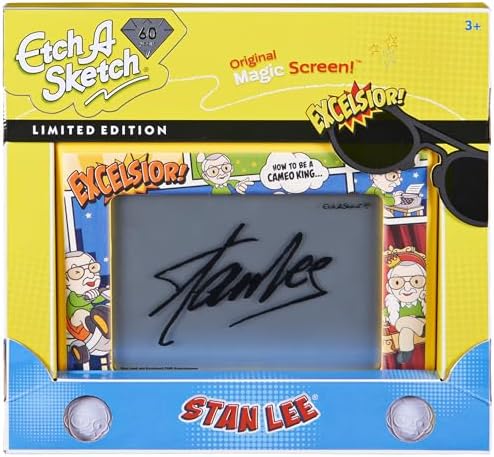
Inside the frame
How the magic screen actually works
People have been flipping our toy over for sixty-plus years looking for the battery door. There is none. Here is what is actually in there.
The silver on the glass
The back of the gray screen is coated with extremely fine aluminum powder, mixed with tiny plastic beads that keep it from clumping. The powder clings to the glass on its own, the way dust clings to an old television. That silver coat is what you are looking at when the screen is blank.
The stylus that never lifts
Behind the glass sits a small stylus mounted on two crossed rails, pulled around by wires that wind onto the knobs. The left knob drags it sideways, the right knob drags it up and down. Turn both and the two pulls add up into a diagonal or a curve.
The tip presses against the glass the whole time. Wherever it travels, it scrapes the powder off, and you see straight through to the dark inside of the case. That is the line. Nothing is being drawn on. Something is being scraped away.
Why the line cannot skip
Because the stylus never leaves the glass, every move you make is part of the drawing. There is no picking up the pen and starting elsewhere. This is the whole discipline of the toy: you plan a route, or you learn to fold your mistakes into the picture.
The shake
Turn the frame face down and shake. The powder tumbles across the glass and recoats the scraped path, the same way snow fills a footprint. Flip it back and the screen is blank again. The mechanics have not changed since 1960, because a thing this simple has nothing left to break.